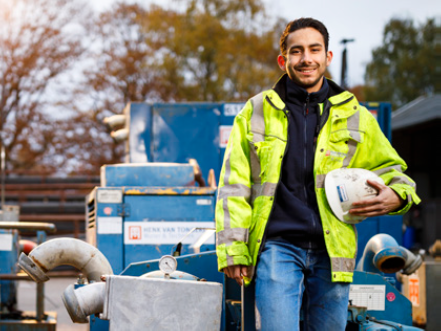
The Dewatering Institute (TDI) proudly spotlights outstanding professionals in the dewatering and groundwater engineering field through its monthly interview series. This edition features Bas Davies, Project Manager at Bronbemaling.com Netherlands.
Bas is a passionate project manager specialising in sustainable groundwater technology. With a bachelor’s degree in Land and Water Management and a postgraduate qualification in Project Management, he has built his career around innovation and climate-adaptive water solutions. Having worked in both field operations and consultancy, Bas combines technical expertise with strong leadership and a focus on knowledge sharing. At Bronbemaling.com , he leads projects that connect sustainability and innovation, including large-scale rainwater infiltration and dewatering systems. Recognised for his forward-thinking approach, Bas represents the new generation of professionals driving progress in groundwater management.
What stage are you at in your career right now?
I am transitioning form a building phase to an acceleration phase in my career. I have mastered my craft and am already thinking strategically. Now is the time to gain more influence.
What led you to the dewatering field, and what motivated your choice?
I have had a fascination with (water) flow my entire life. After completing my studies, I was looking for a job. At Bronbemaling.com, I was able to start as a working student, where I learned the practical fundamentals of how groundwater behaves in the soil. That’s where I fell in love with the sector.
Have any projects been instrumental in launching your career?
These were projects in which innovation and sustainability were leading principles. One of them involved a dewatering project near a nature reserve, where multiple stakeholders and environmental interests had to be carefully balanced.
To serve all interests, we developed and implemented an innovative dewatering system in which groundwater drawdowns and discharge rates could be adjusted in real time. This adaptive approach ensured environmental protection while maintaining operational efficiency.
In addition, I led a European-funded project focused on developing a new pre-filtration system to enable deep infiltration of rainwater into the subsurface. This project laid the foundation for our current rainwater infiltration system, which continues to be expanded and further developed.
What do you predict will be the most significant challenges for the industry in the future?
In the coming five years, dewatering in the Netherlands will face stricter legislation and more complex permitting procedures. Climate change in combination with geographic location of the Netherlands will also cause greater fluctuations in groundwater levels, making design and execution more challenging. At the same time, increasing pressure to use groundwater more sustainably will grow as it becomes scarcer. This will require further professionalization, improved risk management, and greater technological innovation within the sector.
In what ways do you envision technology influencing the industry in the coming years?
Technology will strongly influence the dewatering industry through smarter monitoring, data-driven decision-making, and more sustainable solutions like return dewatering. Real-time systems and improved modelling will reduce risks and optimize performance. At the same time, innovations in water treatment and reuse will become increasingly important. As groundwater becomes scarcer, we must think more consciously about how we use it and manage it in a more responsible and sustainable way.
What elements of the industry do you believe require improving?
I believe our sector sometimes lacks a certain level of professionalism. What I mean by this is that in dewatering, many factors come into play, such as discharge rates, drawdowns, and associated risks. In the Netherlands, these aspects are not always adequately addressed in projects, which can lead to problems. At the same time, we live in an era in which groundwater is becoming increasingly scarce. Therefore, groundwater as a resource should be handled with greater awareness and responsibility.
Why do you think TDI is important for the industry and how it can help the industry develop?
TDI can act as an advocate for the sector and help connect companies within its network. By bringing parties together, new ideas and technologies can be shared at an earlier stage. This collaboration enables challenges to be addressed proactively, often before they even arise.
Ultimately, who stands as your most enthusiastic advocate?
This concerns Robert Barkel & Guido van Tongeren. Robert has believed in my abilities from the very beginning, eight years ago. His confidence in me has enabled me to fully realize and demonstrate my potential. At the moment, Guido is helping me further develop my capabilities and giving me the opportunity to focus on the work that gives me energy.