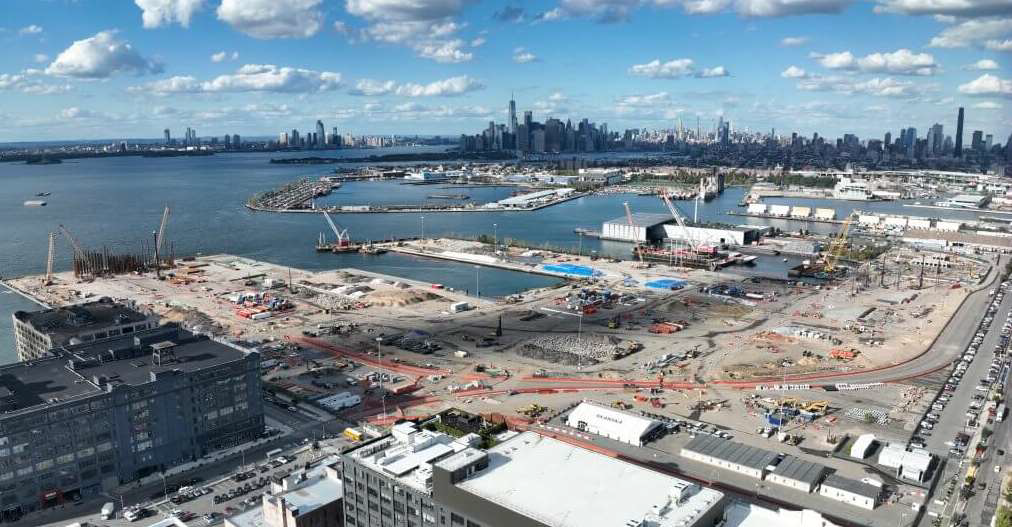
South Brooklyn Marine Terminal is site to a major revitalization project that is in the process of upgrading the existing 73-acre port facility to support staging, preassembly, installation and operation of Equinor’s Empire Wind project. Empire Wind is an 810 megawatt offshore wind turbine project located 15-30 miles off the coast of Long Island and aims to deliver renewable energy to approximately 500,000 New York homes. This will be one of the largest dedicated offshore wind hubs in the United States and will be the first offshore wind farm to connect directly to New York City’s power grid.
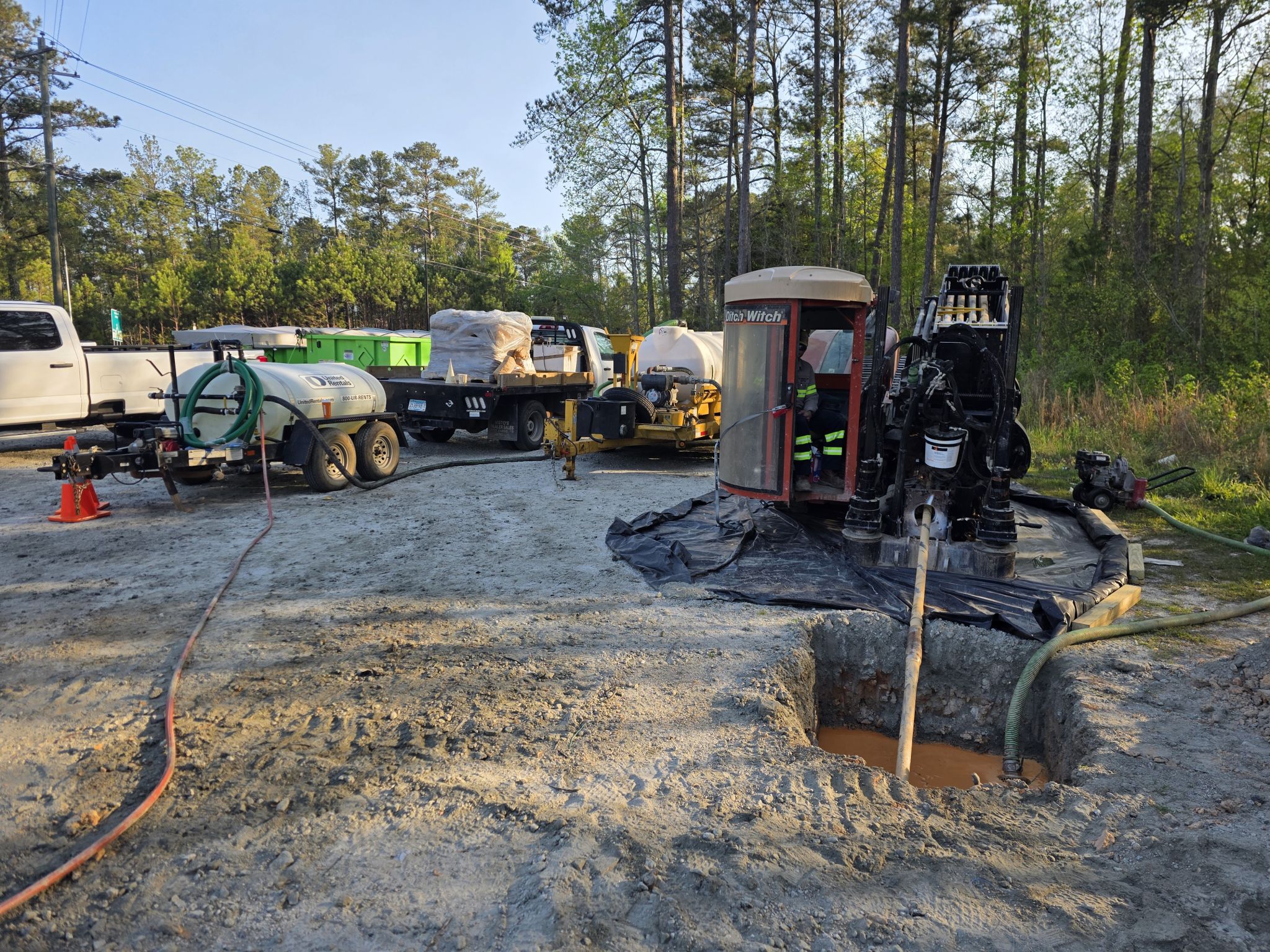
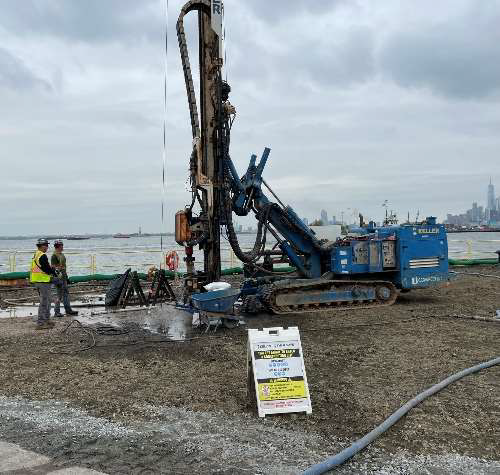
The Skanska JV was awarded the contract for the new crane pads and site utilities. Keller was contracted by Skanska Civil USA to provide wellpoint dewatering for the crane pad and utility excavations in tandem with temporary water treatment of the discharge from the dewatering systems and construction sumps prior to final discharge into the Gowanus Bay. The original wellpoint dewatering scope included 772 wellpoints installed to a depth of 30 feet to provide dewatering for thirty-nine (39) excavations. The work was to be completed with six (6) wellpoint pumps, one (1) wellpoint system setup crew that was dedicated to relocating systems to excavations requiring dewatering and one (1) drill rig crew and for a total of five (5) crew members.
However, differing site conditions determined that a greater dewatering effort was required than initially anticipated. The differing conditions resulted in a scope expansion that added several new excavations to be dewatered and increased Keller’s wellpoint quantities for the originally planned excavations. Due to the scope increase, an acceleration to the project schedule was required which led to seventeen (17) wellpoint pumps and three (3) drill rig crews for a total to thirteen (13) crew members at the peak of the work. The excavations requiring dewatering ranged from small pits for precast utility structures with as little as eight (8) wellpoints to large excavations for major infrastructure upgrades requiring up to eighty-seven (87) wellpoints at a single location. At the completion of Keller’s work a total of 1,504 wellpoints were installed to dewater eighty-four (84) excavations. This included the setup and breakdown of wellpoint pumps at each excavation and 8,670 feet of vacuum header, which based on the needs of the system, utilized 6-inch and 8-inch pipe.
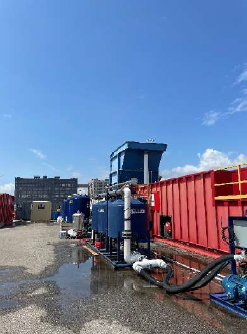
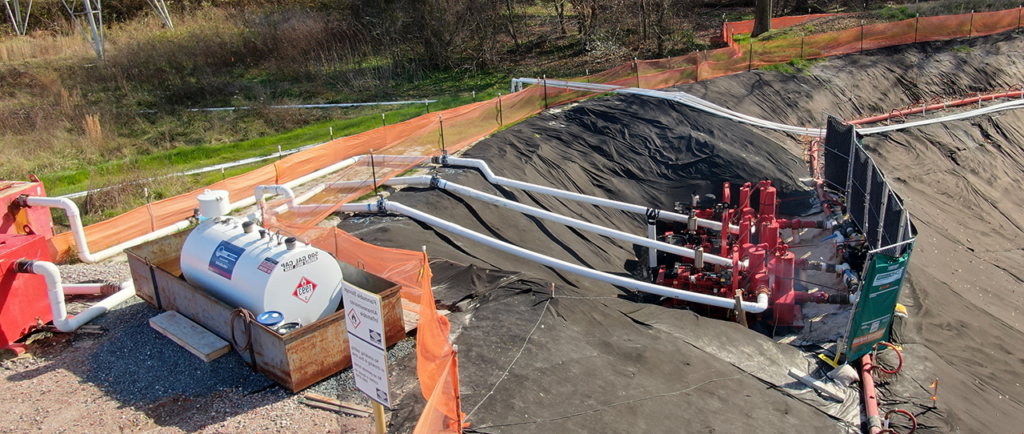
The system was designed to raise the pH of the water with sodium hydroxide to promote metal precipitation and inject a polymer and a coagulant to assist with the flocculation of the precipitated metals and suspended solids. The coagulated metals and suspended solids are then settled out with an inclined plate clarifier and thegenerated sludge is rerouted to three (3) dewatering boxes to allow accumulated sludge to settle and water to be decanted back to the influent of the system to be processed. After the metal precipitation process, the water was directed to an additional pH adjustment system that used sulfuric acid to decrease the pH to within discharge requirements. Once the water’s pH is within discharge requirements it is processed through a sand filter unit, a duplex bag filter unit, two (2) reactivated carbon vessels and two (2) mercury removal media vessels.
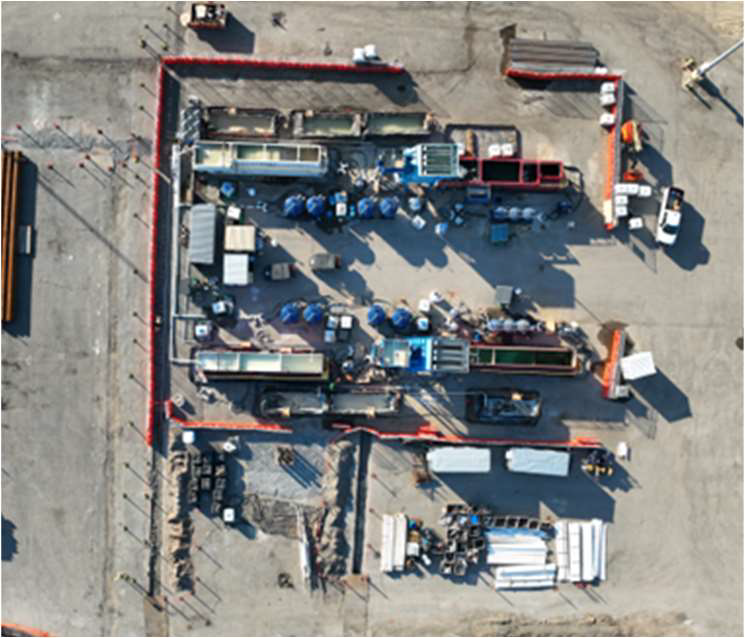
The water treatment scope required temporary treatment to address contaminated construction water and groundwater prior to discharging to the Gowanus Bay. Keller initially proposed three (3) 500 gallons per minute (gpm) treatment trains which were to be operated in parallel to achieve a total treatment capacity up to 1,500 gpm. The systems were designed to treat only total suspended solids (TSS) and nondissolved metals utilizing mechanical filtration. After several iterations to the project schedule and scope, the final contract included six (6) 500 gpm treatment trains to reduce levels of TSS, dissolved metals including mercury, and any volatile and semi-volatile organic compounds (VOCs and SVOCs) that may be encountered. Each treatment system utilized transfer pumps, pH adjustment systems, a polymer injection system, settling tanks, an incline plate clarifier, a sand filter unit, bag filter units, reactivated carbon media and media specialized for the removal of dissolved mercury.
Construction of the first treatment train started on 6/17/2024 and installation of the sixth and final train was completed on 9/13/2024. The treatment trains were operated 24 hours a day, 7 days a week. As the utility work is winding down and the need for dewatering has been reduced Keller has begun demobilization of the wellpoint dewatering and treatment systems. As of August 2025, Keller has treated approximately 450,000,000 gallons of contaminated water and has accumulated 21,925 man hours towards the project. This is the biggest dewatering effort to date in New York City.